The Same Facts, in a Different Order
See how the same facts in a different order can change a news story’s impression, and learn to spot what the opening emphasizes or leaves behind.
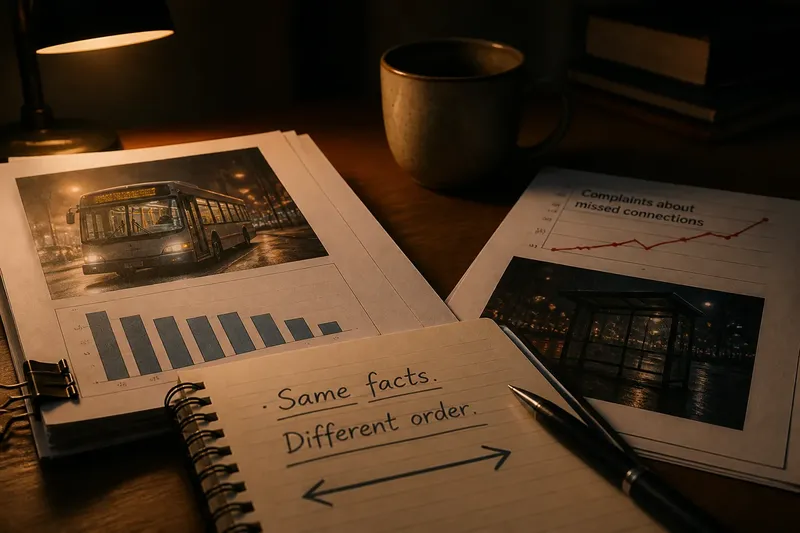
A city council’s report says a bus route carried fewer riders after a schedule change, while complaints about missed connections also rose. Put the ridership figure first, and the change can sound like a response to weak demand. Lead with the complaints, and it can sound like a service problem. The same facts in a different order can guide a reader toward different first impressions before any fact has changed.
That does not automatically mean a report is misleading. Writers have to choose what to lead with, and readers have to decide what deserves attention. The useful question is not only whether each detail is accurate, but what the sequence makes feel important, settled, or secondary. These five ways of reading order help separate the evidence from the impression built around it.
1. What does the opening make feel like the main event?
Readers often treat the first concrete fact as the story’s center. If a report begins with the decline in bus ridership, the schedule change may seem to be about efficiency or demand. If it begins with missed connections, the same change may seem to be about access and reliability. Neither opening erases the other detail, but each sets a first frame.
To notice that frame, pause after the opening paragraph and state the apparent main point in plain language. Then ask whether the next paragraphs support that impression or complicate it. If the story’s central subject shifts as new facts arrive, the opening may be a narrow entry point rather than a complete account.
This is similar to arranging objects on a desk: the item placed in the middle attracts attention, even if everything remains visible. The placement is meaningful, but it is not proof that the other objects do not matter.
2. Which fact gets the most space and detail?
Order is only part of emphasis. A story can mention two relevant facts, then devote several paragraphs to one and a brief clause to the other. A detailed account of falling ridership may include neighborhood comparisons, a timeline, and commentary from transit officials. Missed connections may appear once near the bottom. A reader can reasonably come away with a stronger impression of the ridership issue.
Look at how much explanation each fact receives. Does the report give causes, examples, or context for one side but not the other? Are people affected by the change described in detail, or does the story rely mostly on institutional summaries? The difference may reflect what information was available, but it still shapes what feels substantial.
Notice verbs and labels, too. “Ridership fell” describes a change. “Riders abandoned the route” suggests a motive that the figure alone may not establish. A writer’s word choice can make a fact sound like a judgment. Check whether the story supplies evidence for that extra implication.
3. Does the sequence imply cause or responsibility?
When one event appears immediately before another, readers may connect them. A report might say that the transit agency changed the schedule, followed by fewer riders and more missed connections. The sequence can suggest that the schedule change caused both outcomes. But order in a story is not, by itself, evidence of cause.
Ask what the report says about timing and other possible explanations. Did the ridership decline begin before the schedule changed? Were routes, fares, or service conditions changing at the same time? Does the story distinguish what officials believe from what the available records establish? These questions help keep a plausible link from turning into a settled conclusion.
Also notice where responsibility appears. A report can place an agency’s explanation before riders’ accounts, or the reverse. That choice may affect whose interpretation readers encounter as the default. The important thing is to identify who is making each claim and what support the report provides, rather than treating the first explanation as the final one.
4. How can you compare two arrangements without changing the facts?
Imagine you are editing a short report using only these details: after a bus schedule change, recorded ridership was lower; complaints about missed connections increased; the agency says the new schedule was intended to improve transfers; and the report does not establish why the two outcomes changed. One version could begin with the lower ridership, then give the agency’s reason, then mention complaints and the limits of the evidence. Another could lead with complaints, explain the intended transfer improvements, then give the ridership figure and the same limit.
The first arrangement gives demand and agency planning early prominence. The second gives riders’ experience the opening position. Neither should claim that the schedule change caused the outcomes, because the stated facts do not establish that. A fair comparison preserves the same qualifications and does not quietly add a motive or explanation to make one version more persuasive.
You can try this as a reading exercise. Write down the story’s main facts in neutral phrases, then imagine moving the lead fact to the end. Ask what impression changes and which details remain equally supported. This is not a substitute for checking a report; it is a way to see the role sequence plays in your own first reaction.
5. What should you ask when the order changes your impression?
When a story feels one-sided, use targeted questions rather than assuming the writer has distorted it. The answers may reveal a justified emphasis, a missing qualification, or simply a different editorial choice.
- What is the first claim? Separate the opening fact from the larger conclusion it seems to invite.
- What arrives later? Look for qualifications, counterevidence, affected people, and limits on what is known.
- Which details receive explanation? Compare the space, examples, and context given to competing parts of the account.
- What does the sequence connect? Check whether the story supports a causal link or only reports events in succession.
- Would another order change the mood? If so, identify the fact that creates the shift and decide whether its placement is justified by the report’s focus.
These questions are especially useful when a headline and opening seem to settle the meaning before the article has presented its qualifications. Read on before deciding that the first detail is the whole story. If the later material substantially changes the initial picture, give that material real weight rather than treating it as a footnote.
Which questions help you read order carefully?
Does a later detail matter as much as the lead?
It can. A qualification placed later may narrow or change the opening claim, so judge its substance rather than its position on the page.
Does a vivid anecdote prove a wider pattern?
No single account establishes how common an experience is. Treat it as an illustration unless the report connects it to broader evidence.
Can two fair reports start with different facts?
Yes. Editors may choose different entry points while accurately preserving the same evidence and uncertainty. Compare what each includes and supports, not just which lead feels more convincing.
What if the story never explains why events changed?
Keep the gap visible in your own reading. You can say what happened according to the report without assigning a cause it does not establish.
How can you finish with a more balanced impression?
Before sharing a strong reaction, summarize the report in two parts: what it establishes, and what it leaves unresolved. For the bus example, that might be that ridership was lower after a schedule change and missed-connection complaints increased, while the report does not establish what caused either result. This wording keeps chronology, evidence, and explanation distinct.
Then return to the opening and ask whether it earns its prominence. A lead can be useful because it identifies the most consequential fact, even if other details follow. But if a later qualification changes the meaning, your final impression should include it. Reading order carefully does not require suspicion of every writer; it means noticing how placement steers attention and letting the full set of facts, not the first one, shape your judgment.