Who Is Speaking, and How Would They Know?
Learn how to assess witnesses, specialists, and institutional statements by matching each source’s access and expertise to the claims they can support.
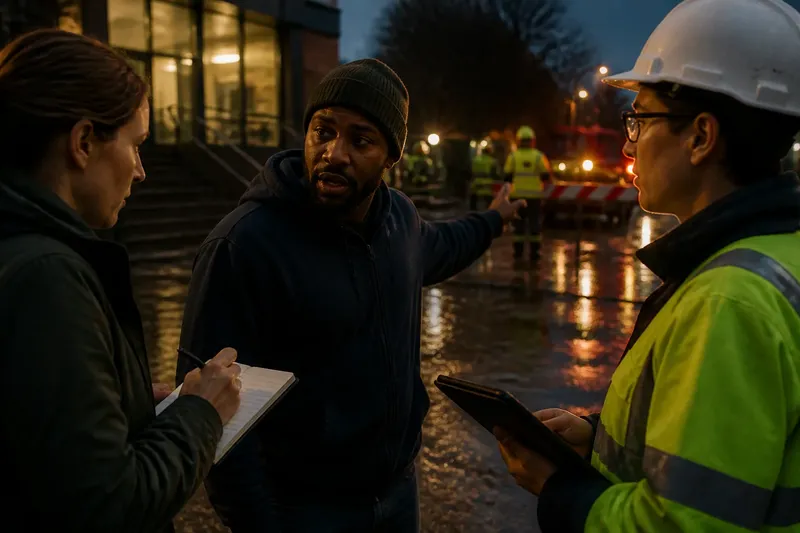
A witness says the water in the street reached the bottom step; an official says crews have closed the bridge; a specialist explains why the current may be dangerous. In a report about a flood, all three voices can matter, but they know different things. Reading news sources well begins with one practical question: who is speaking, and how would they know?
That question keeps a source’s words in their proper lane. A person can be credible about what they saw without knowing what caused it. A specialist can explain a technical process without having been present. An institution can report its own actions while leaving independent questions unanswered. Treat each source like a different tool in a kitchen drawer: useful for its job, not interchangeable with every other tool.
What can a firsthand witness actually establish?
A firsthand witness can describe an experience or observation: what they saw, heard, smelled, or did. In a report about a building evacuation, someone who was inside may describe an alarm sounding, people leaving, or smoke in a hallway. Those details can help readers picture events as they unfolded.
But direct experience has boundaries. A witness who saw smoke may not know where it began. Someone who heard a loud noise may not know whether it came from equipment, a vehicle, or something else. A person can be honest and mistaken about details, especially in a confusing or stressful moment. Sincerity and certainty are not the same as complete knowledge.
Look for the wording around the account. Does the report say the person saw the event, or that someone told them about it later? Is the observation specific, such as “I heard the alarm,” or does it make a broader claim, such as “the alarm system failed”? The first statement describes an experience; the second may require records, technical inspection, or other evidence.
Pay attention to timing and vantage point, too. A person watching from across a street may see a crowd gather but miss what happened inside a room. Someone who arrived afterward can describe the scene they encountered, not necessarily the event that created it. News reports should make those distinctions clear when they affect the claim.
What can a named specialist explain?
A specialist’s value comes from relevant knowledge, not simply from a title. A fire investigator may explain how investigators distinguish possible causes. A transportation engineer may clarify how a road design affects visibility. A medical specialist may explain a term used in a public health report. The useful question is whether the person’s expertise matches the subject being discussed.
Specialists can place an event in context, explain technical language, and describe what evidence would be needed to support a claim. They can also identify plausible explanations without deciding which one occurred. If an expert says a particular pattern “can be consistent with” a cause, that is not necessarily a finding that the cause has been established.
Check what basis the specialist gives. Are they interpreting a document, describing established professional knowledge, reviewing material supplied by a reporter, or speaking from direct involvement? Those are different roles. A specialist who has not examined a site may still explain general principles, but should not be treated as an eyewitness to that site.
Credentials are worth reading in context. A person may be highly qualified in one field and outside their expertise in another. A relevant affiliation can help readers understand a perspective, but an affiliation alone does not settle whether an explanation is sound. Notice whether the report identifies the person’s expertise and makes clear what material they considered.
What can an institutional statement establish?
An institutional statement is an account from an organization, such as a city department, company, school district, police agency, or hospital. It may establish what the organization says it has done, what policy it describes, or what information it is releasing. For example, a department can announce that it has closed a facility. That announcement is direct evidence of the department’s stated action.
It does not automatically establish every explanation attached to that action. An organization may have records, staff knowledge, and formal responsibility, but it may also have an interest in how events are understood. A company’s statement about a product issue is relevant to what the company says; independent inspection or customer records may be needed to evaluate wider claims.
Notice whether the source is speaking for the institution or personally. A spokesperson may be authorized to communicate an official position, while a staff member speaking in an individual capacity may not represent the organization. The difference matters when a report attributes a statement or describes a policy.
Also look for what the statement leaves open. “We are reviewing the incident” confirms that a review is underway, but does not say what the review will conclude. “We have not received reports” describes the organization’s current account, not necessarily the absence of an event. Precise wording prevents a statement from carrying more weight than it can support.
How can you match a source to a claim?
When a report makes an important assertion, pause at the attribution. Ask what the source had access to, what expertise they bring, and whether they are describing an observation, an interpretation, or an official position. Then compare that role with the claim.
- For an event detail: Ask whether the source was present and had a clear view or other direct access.
- For a technical explanation: Ask whether the speaker’s expertise fits the subject and whether they explain the basis for their view.
- For an organization’s action: Ask whether the source is authorized to speak for it and whether the claim is about the organization’s own conduct.
- For a claim about cause or responsibility: Look for evidence beyond a single person’s impression or an interested organization’s account.
- For conflicting accounts: Notice whether the report identifies what each source knows and what remains unresolved.
Say you read a local report about a school closing after a strong chemical smell was reported. A student who noticed the odor can describe when and where it was present. A chemistry specialist can explain why smell alone does not identify a substance. The school district can confirm that it closed the building and describe its stated response. None of those voices, by itself, necessarily establishes what the substance was or where it came from. The useful next question is what records, inspections, or other direct evidence the report cites.
This is not a demand that every source prove every detail. It is a way to keep claims proportionate. A witness account may support the fact that a person experienced something; it may not support a broad claim about everyone’s experience. An institutional statement may establish a public position; it may not resolve an independent question about the institution’s conduct.
What should you ask when a source is unclear?
Does “witness” mean firsthand?
Not always. Check whether the person saw or heard the event themselves, or learned about it from someone else. A report should distinguish direct observation from secondhand information when that difference affects the claim.
Can a specialist speak about this specific event?
A specialist can explain relevant concepts without having examined the event itself. Look for whether they are offering general context, interpreting available material, or making a case-specific judgment, and read their conclusion within that scope.
Does an official statement confirm the underlying claim?
It confirms what the institution says, and may document its own actions or records. For a claim about cause, impact, or responsibility, look for what evidence supports it beyond the statement’s authority.
What if sources disagree?
Compare their access, expertise, and reasons for speaking rather than choosing the most confident voice. A careful report may explain the disagreement and identify what evidence could clarify it, while leaving a question open in the meantime.
How can you build a steady reading habit?
Use a brief routine when a story matters to you. It need not turn reading into an investigation. The point is to notice the source behind a claim before the claim hardens into a conclusion.
- On first reading, mark the main claim. Notice the sentence that tells you what happened, what caused it, or what an organization decided.
- Identify who supports that claim. Separate named witnesses, specialists, institutional representatives, documents, and unnamed sources rather than treating them as one pool of evidence.
- Check the source’s access. Ask whether the person observed the event, examined relevant material, or learned about it through another source.
- Check the source’s role. Consider whether the person is explaining a field, representing an organization, or describing a personal experience.
- Match the strength of the wording to the support. “Says,” “describes,” “suggests,” and “confirms” do not mean the same thing.
- Keep unresolved points unresolved. If the report does not establish a cause or settle a dispute, note that boundary instead of filling it with a guess.
Once the routine becomes familiar, source labels stop being decoration. “Witness,” “expert,” and “official” become prompts to ask what that particular person can know, and where their knowledge ends. That is the heart of reading sources carefully: not dismissing a voice, and not asking it to speak for evidence it does not possess.
For a quick check, return to the main search phrase: who is speaking, and how would they know? Apply it to the claim, not just the person’s title. A source can be trustworthy within a narrow scope and still leave the larger question open. Keeping that distinction visible lets you learn from a report without confusing a useful account for a complete one.